
Christmas Exhibition
2026
Our Christmas 2026 Exhibition features artists from across the United Kingdom, delivering Ceramics, prints, wood fired slipware, wood turning, glass, metal sculpture and ceramic sculpture.
Contact us directly if you would like to find out more about our artists featured below or purchase one of their pieces.
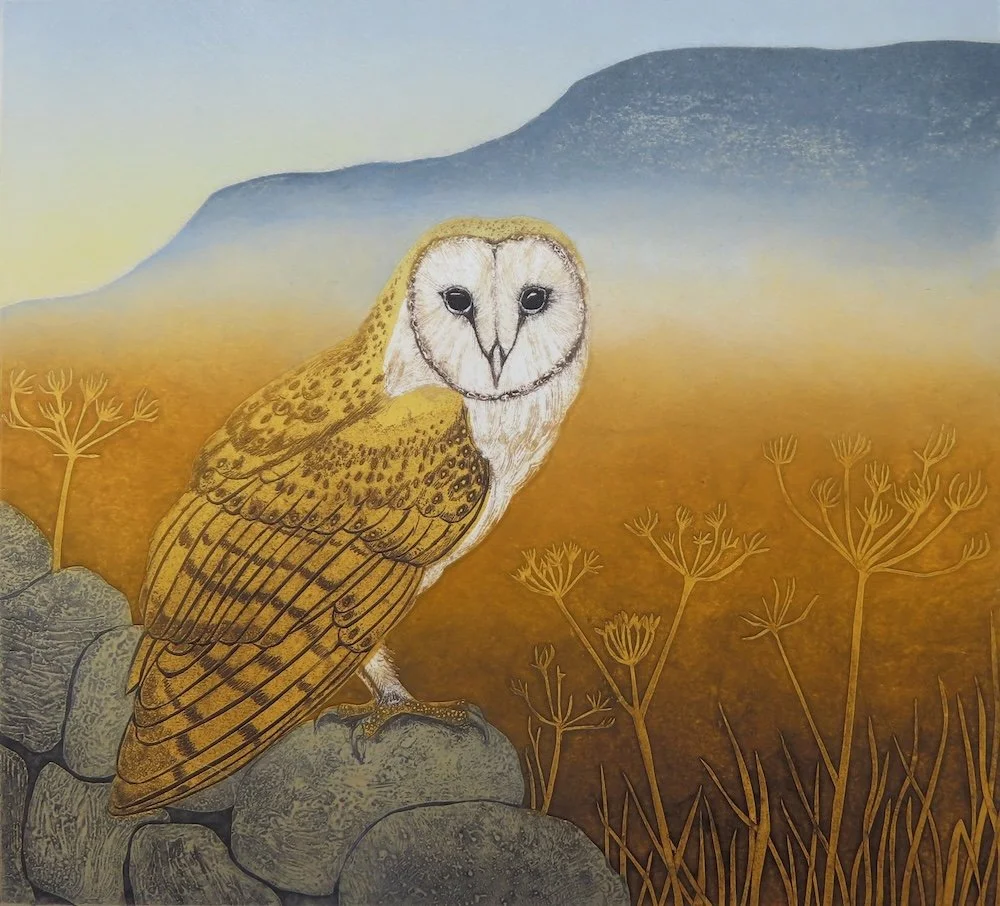
The Golden Hour
Hester Cox
"Years of fell running have shaped my relationship with the landscape and natural history of the Yorkshire Dales, an influence that is evident in my printmaking. The physicality of running combined with the solitude and necessary awareness of my immediate environment creates a deep connection with the land that lasts long after I have returned to the studio. Revisiting the same areas repeatedly provides me with the opportunity to catch a glimpse of some of the more elusive birds and animals that inhabit these environments. An image may be inspired by a wildlife encounter or objects that I have collected such as a feather or bone. I carry a battered compact camera and take photos to use for reference, sketching and writing notes to distil ideas. I specialise in collagraph a technique that offers a wide range of possibilities. I like to combine intentional cut and scratched detail with looser painted textures contrasting naturalism with stylisation. When each plate is inked and printed, there is always a compelling element of surprise. Lately, I have been collaborating with museums and ecological groups, using my prints to highlight the fragility of our natural habitats and the species they sustain."
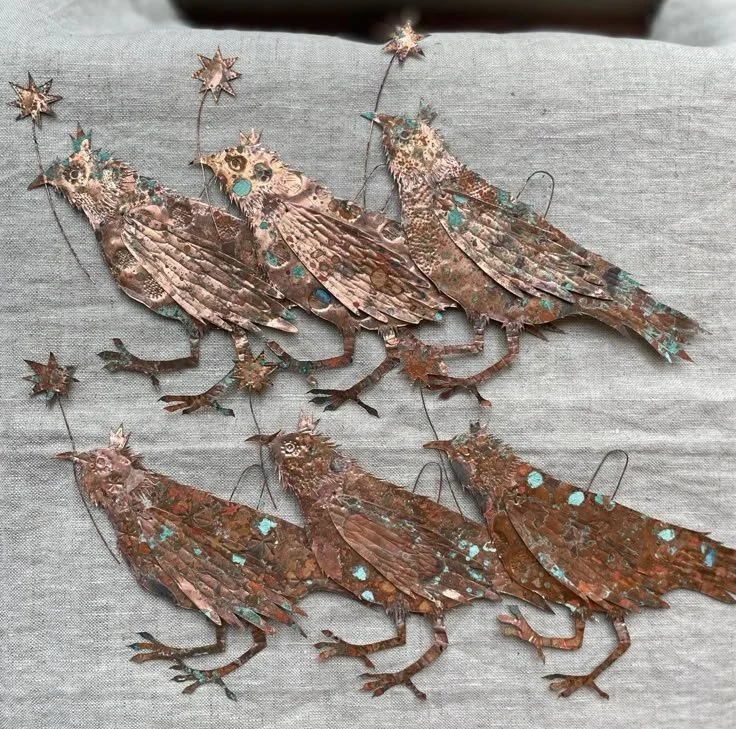
Rowan Macgregor
Rowan is an artist making delicate copper sculptures. She is inspired by her love of the British countryside, nature, history and folklore and this is reflected in her work.
Each piece Rowan makes is different and unique - she wants them to look like bits of buried treasure or antique folk art.
Karlin Rushbrooke
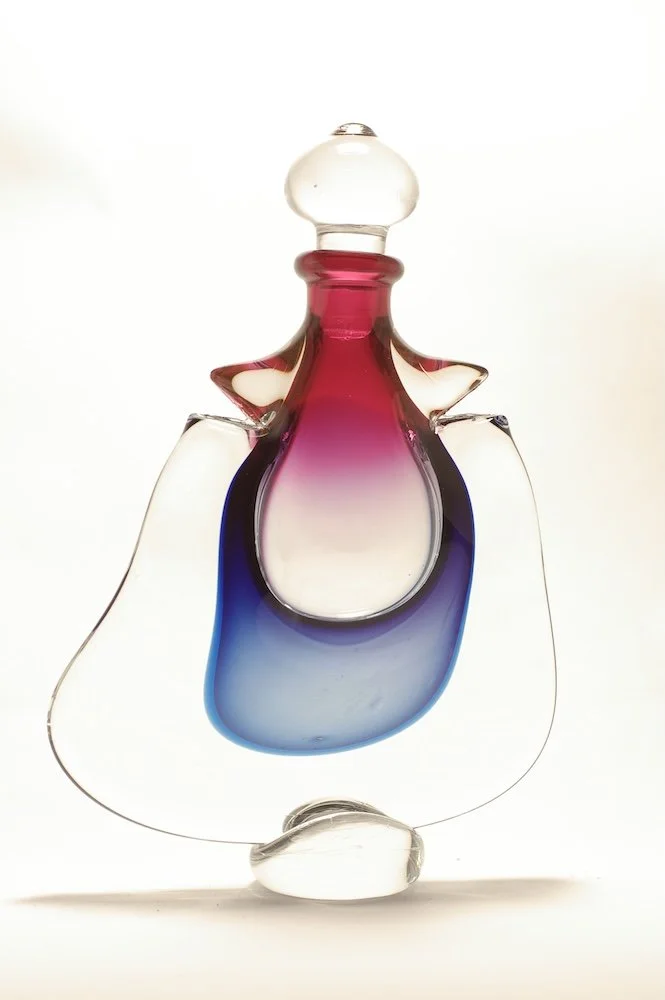
In the mid to late sixties Karlin studied Glass and ceramics at Stourbridge College of Art and Design. When the small furnaces were introduced from America in the late sixties, Karlin was one of the first glass makers to set up their own studio in the early seventies. Karlin Rushbrooke Glass was born in 1973 and he never looked back.
Relocating to Herefordshire in 1974 he became an established figure in the British Glass world and was made Chairman of British artists in glass in 1979. The same year he began teaching glass at Bristol Polytechnic (1979-1982) At the same time he helped his wife Greta set up a Waldorf Kindergarten, which is now a thriving Steiner Academy with over 300 children. He says of his work, “I have been a glass blower for the last forty odd years. Strong simple shapes with presence is my goal."
His glass is exhibited in some of the country’s finest collections, including British Craft Council, Victoria and Albert, Dudley Glass Museum and the Dan Klein & Alan J Poole Private Collection which is now housed at the National Museums Scotland, in Edinburgh. More recently Karlin has also created sculptures in steel - occassionally combining it with glass.
James Burnett Stuart
James makes pots for eating and drinking, out of earthenware clay. He likes the role pottery plays in the household, giving quiet pleasure, and even prompting contemplation. The qualities he admires in pottery are warmth, sensuousness, softness, depth, earthiness.
James originally learnt about pottery making on the Harrow Studio Pottery course 1986-8. It was a success! More of a success than his English Literature degree, though he have never regretted that. By the end of Harrow James had enough skills and know how to set up his first workshop in an old glass factory in Ealing. A few years later he moved to a boatyard on Eel Pie Island, Twickenham. Here James made quite large quantities of pots for the Conran Shop and Designers Guild. During the 1990’s he spent periods of time at Charleston Farmhouse as resident potter. Since 2006 James has been making his pots in a barn next to his home just outside Kington in Herefordshire.
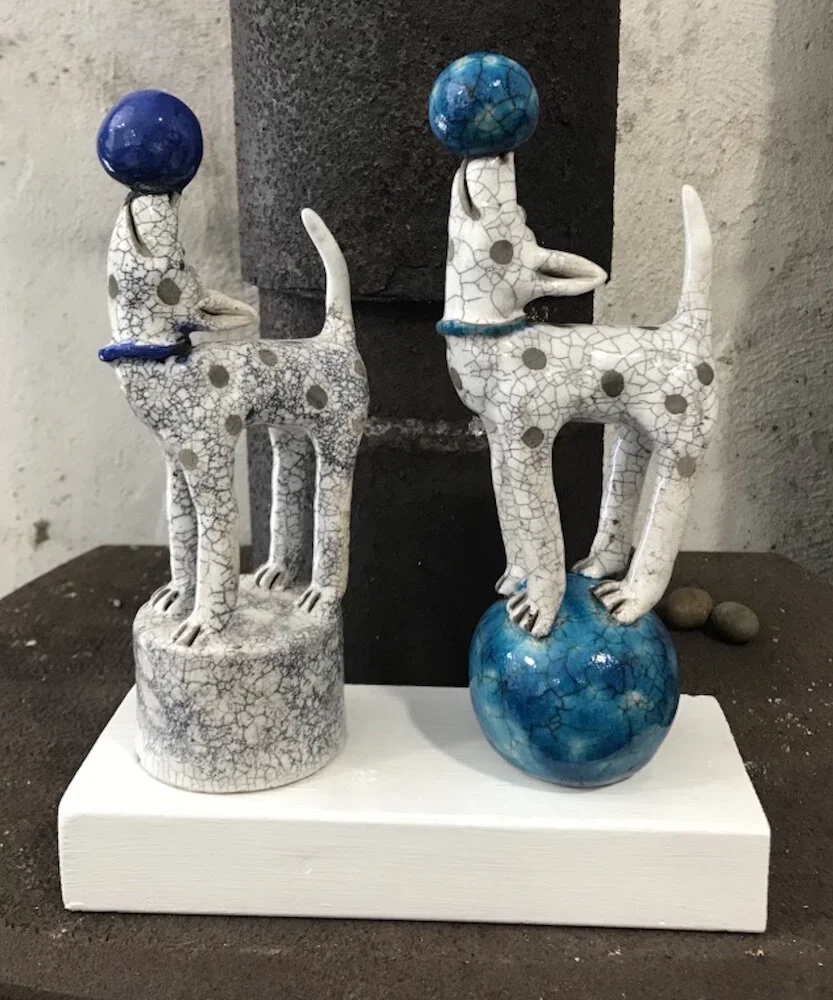
Demelza Whitley
Demelza’s work is narrative, she is influenced by folk stories/myths and the everyday things in her life. The things she sees or hears, words, overheard snippets of conversations spark her imagination.
Born and raised in West Penwith, Cornwall, surrounded by the sea, boats regularly appear in Demelza’s work often with the quirkiness of added wheels. As for dogs, some might say she is a little obsessed with them. Her own two dogs are her models, her muses; they don’t stand still and pose though! Demelza is interested in the history and relationship between humans and dogs.
Demelza completed a degree in contemporary crafts at university college Falmouth in 2008. It was at university that she developed her own paper clay, which she makes using a white stoneware clay from St Agnes. She then Raku fires her work in her garden where her studio is also situated. Demelza particularly likes working with the elements from the clay and water that make the body of her work to the fire that makes it permanent. The weather plays it part too, too wet and windy and she can’t fire the kiln, it’s about working in unison with her environment.
Hannah McAndrew and Doug Fitch
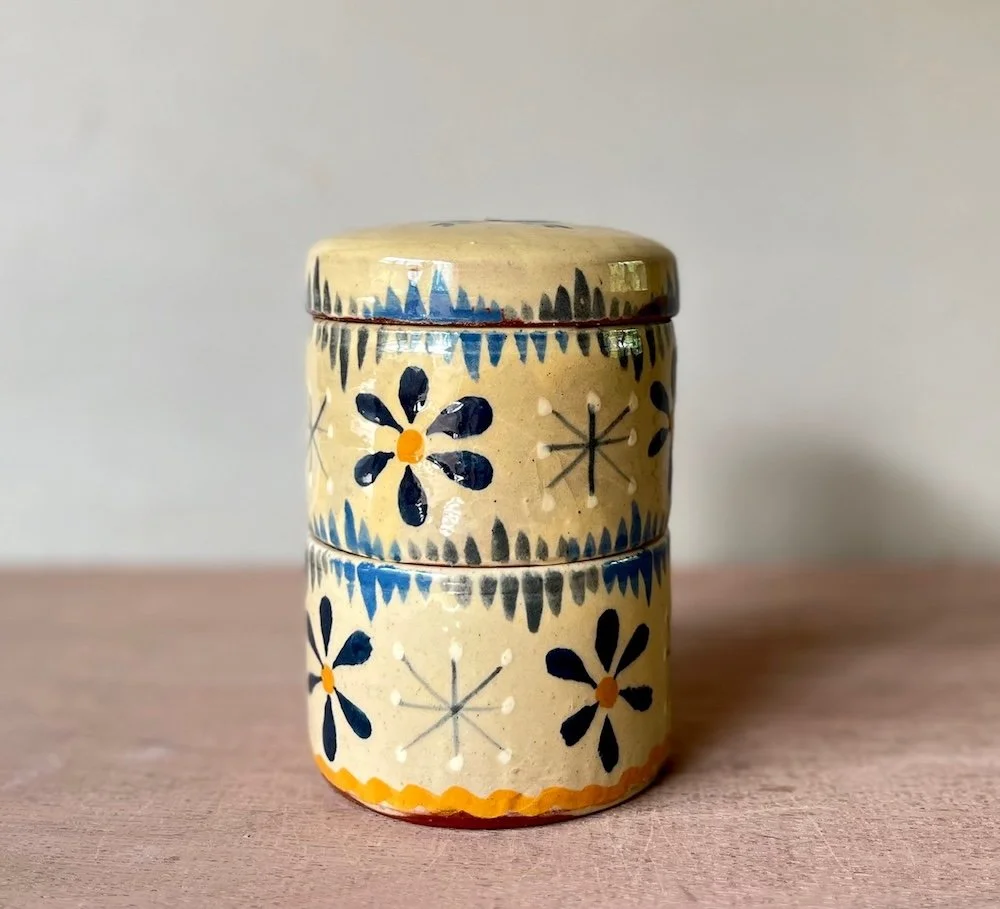
Hannah - “Britain boasts a particularly fine tradition of slipware pottery. I draw on this rich heritage and use it as the basis for my own work, where I attempt to capture the essence of these historical pieces, reinterpreted in a contemporary style.
Predominantly, I make pots with a purpose. However, I enjoy the challenge of creating a piece that will not simply perform its task well, but will be attractive to the eye and instil a sense of comfort and warmth to its surroundings. My pots are thrown in red earthenware clay and decorated using coloured slips. The decoration is applied to the surface of the pot by use of a slip trailer, while the surface is still glistening wet. Sometimes I allow the slipped surface to dry a little, so that I can inscribe motifs with sgrafitto lines. These slips are subsequently enhanced by the addition of a layer of rich honey glaze”
Doug - “I work in red earthenware clay, the pots simply decorated, with appliqué decoration or sgrafitto, using a basic palette of traditional slips that are made from natural raw materials. The majority of my pots are thrown on the wheel with some press moulded dishes, decorated with freely trailed lines.
The forms, principally large jugs, draw influence from the work of the medieval potters of England and the subsequent tradition of slip decorated country pottery that was prevalent in this country until the early twentieth century.
I’ve been making pots for most of my life. It’s a strange thing, to be excited by something as simple as a brown clay jug and I can’t explain it, but it seems that it happens to some people; it just gets under your skin.”
